A clear path from content to website.
A place for the words. A system for the design. A deliberate way to publish both.
Start with the content.
Pages and posts share familiar editorial fields: title, excerpt, body, media and search metadata. Authors and taxonomy give the work context.
Rich text stays rich text. A visual page can display its own body through Content Body, keeping long-form writing separate from the surrounding layout.
A workspace for the whole library.
Search and filter content by publication state.
Manage authors, categories and tags.
Pick images from the shared media library.
Keep an accessible history of saved revisions.
Build the layout from useful pieces.
Arrange sections, columns and grouped content in the visual editor. Add headlines, rich text, images and calls to action, then check phone, tablet and desktop layouts.
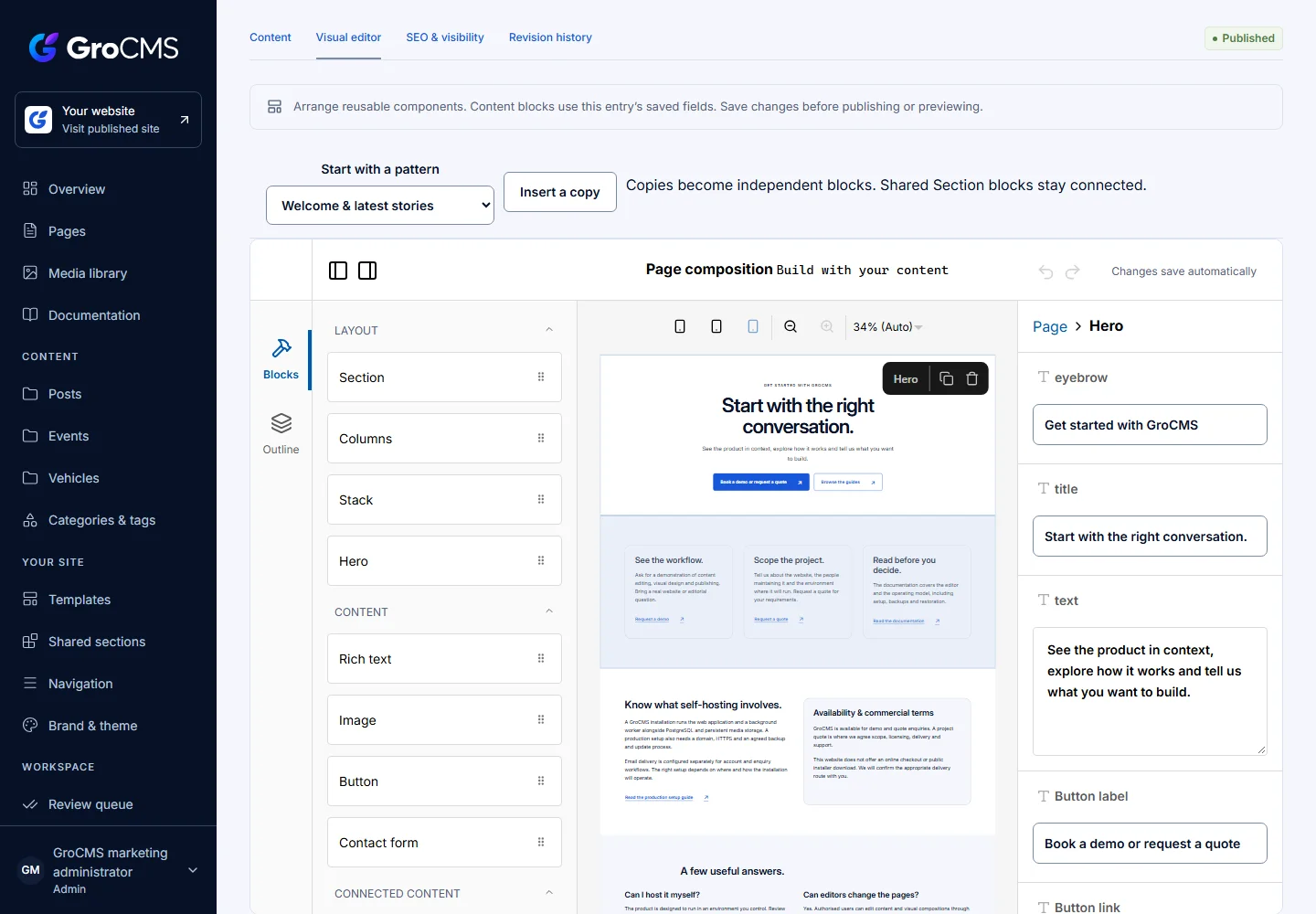
Patterns are a starting point.
Insert a copy and make it your own. Each copied block receives its own identity.
Templates connect the structure.
Reuse a layout for a class of content. Content blocks draw on the entry being displayed.
Shared sections stay shared.
Maintain a common call to action, header or footer and reference it across pages.
Give publishing a clear decision point.
Saving creates a working revision. Publishing makes a selected revision public. Those two actions serve different purposes.
Private previews, exact-revision review and scheduled publication help the team make that decision with context.
Keep the live version steady.
Edit a published page without putting unfinished changes in front of readers.
Review the work that was submitted.
A review refers to a saved revision, even if the author continues editing.
Schedule the version you chose.
The background worker publishes the selected revision when the scheduled action runs.
Make the website feel like yours.
Manage the public name, logo, accent, background and text colours. Choose heading and body font families or upload WOFF2 fonts.
Use consistent navigation and shared sections to connect the experience.
Make something worth sharing.
Thoughtful stories, useful ideas, and the things that move us forward.
Keep the operating model clear.
GroCMS combines a web application, a long-running worker, PostgreSQL and persistent media storage. The documentation explains the jobs of each part.
Scoped API keys and exports are available for suitable integrations and content workflows.
A website worth growing.
Tell us what you are building. We will help you explore whether GroCMS is the right fit.